



What are dark circles under the eyes, and what types are there?
Dark circles are more than just a sign of too little sleep: they can be genetic, exacerbated by lifestyle factors or simply part of your individual skin structure. In this article, you will learn all about dark circles and their causes - and how you can improve their appearance with the right tips.
WHAT EXACTLY ARE DARK CIRCLES UNDER THE EYES?
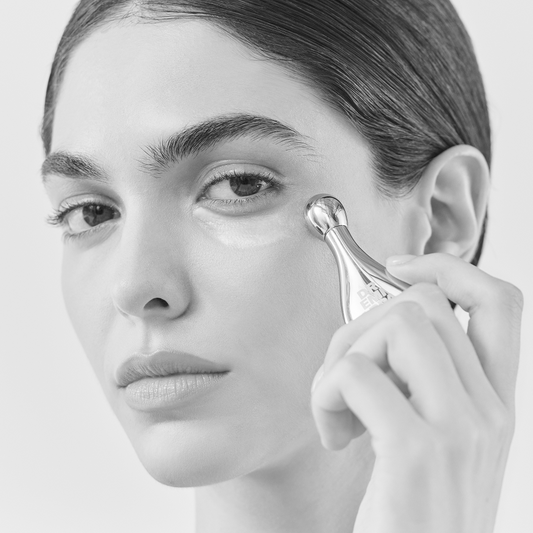
Why do people have dark circles under their eyes? The answer is somewhat complex. From a medical perspective, the periorbital area, also known as the eye area, encompasses the area around the eye socket. It has several distinctive features: The skin here is extremely thin—in some places only 0.2 mm—and thus up to five times thinner than on the cheeks. There is hardly any fatty tissue under the skin, but there is a close connection to the eye muscle. Due to the stronger blood circulation and the sensitive nerve structure, the region is particularly susceptible to stimuli, irritation, and signs of aging. In addition, there is a high level of mechanical stress: up to 10,000 blinks per day put additional strain on the skin.
These factors make the eye area a visible stress barometer for the skin and body. The first signs of periorbital aging, such as fine lines, loss of elasticity, or dry skin, can appear as early as the late 20s or early 30s. The causes are both intrinsic, i.e., genetic, hormonally influenced, or explained by age-related fat loss, and extrinsic, due to factors such as UV radiation, air pollution, lack of sleep, stress, or allergies. As a result of the breakdown of collagen, elastin, and fibronectin, the skin loses its elasticity and structure. This manifests itself in tired eyes, an exhausted appearance, visible bags under the eyes, crow's feet, or drooping eyebrows. Dark circles are caused by thin skin, visible blood vessels, loss of volume, or pigment shifts.
THESE TYPES OF DARK CIRCLES EXIST
Not all dark circles are the same. Their appearance can have very different causes, from translucent blood vessels to pigment deposits to loss of volume or swelling. Here is an overview of the most important types: Dark dark circles (bluish/purple): The eyelid skin is extremely thin and semi-transparent. This makes the subcutaneous vascular network and the eye muscle (orbicularis oculi muscle) more visible, especially if you have a pale complexion. Breakdown products from the blood, such as hemosiderin, can also intensify the dark color. This results in blue-looking dark circles. Pigmented dark circles (brownish/gray): Hyperpigmentation around the eyes is caused by UV exposure, inflammation (e.g., in atopy or contact dermatitis), hormonal influences, or genetic predisposition. This causes increased melanin—and in some cases hemosiderin—to accumulate in the epidermis and dermis. Light dark circles (shadow effects): These occur when the midface is pale or has lost volume, for example in the tear trough. The tear trough is a depression that extends under the eye along the eye contour. Bone loss and sagging, tight supporting structures (ligaments) create visible hollows here – these cast shadows or rings under the eyes, which are more visible in overhead light, while frontal light can partially conceal them.Puffy eyes (puffiness/eye bags): Fluid accumulation due to increased vascular permeability, lymph congestion, salt or alcohol consumption, and morning edema can lead to swelling under the eyes. Age-related changes or increased muscle fullness exacerbate this effect. The swelling can further intensify the dark appearance—often with a purple tint above the muscle.
Important: Some causes are genetic or structural, such as bone shape, fat deposits, or ligaments. These cannot be completely corrected with cosmetics. However, the appearance of rings or circles under the eyes can often be visibly improved.